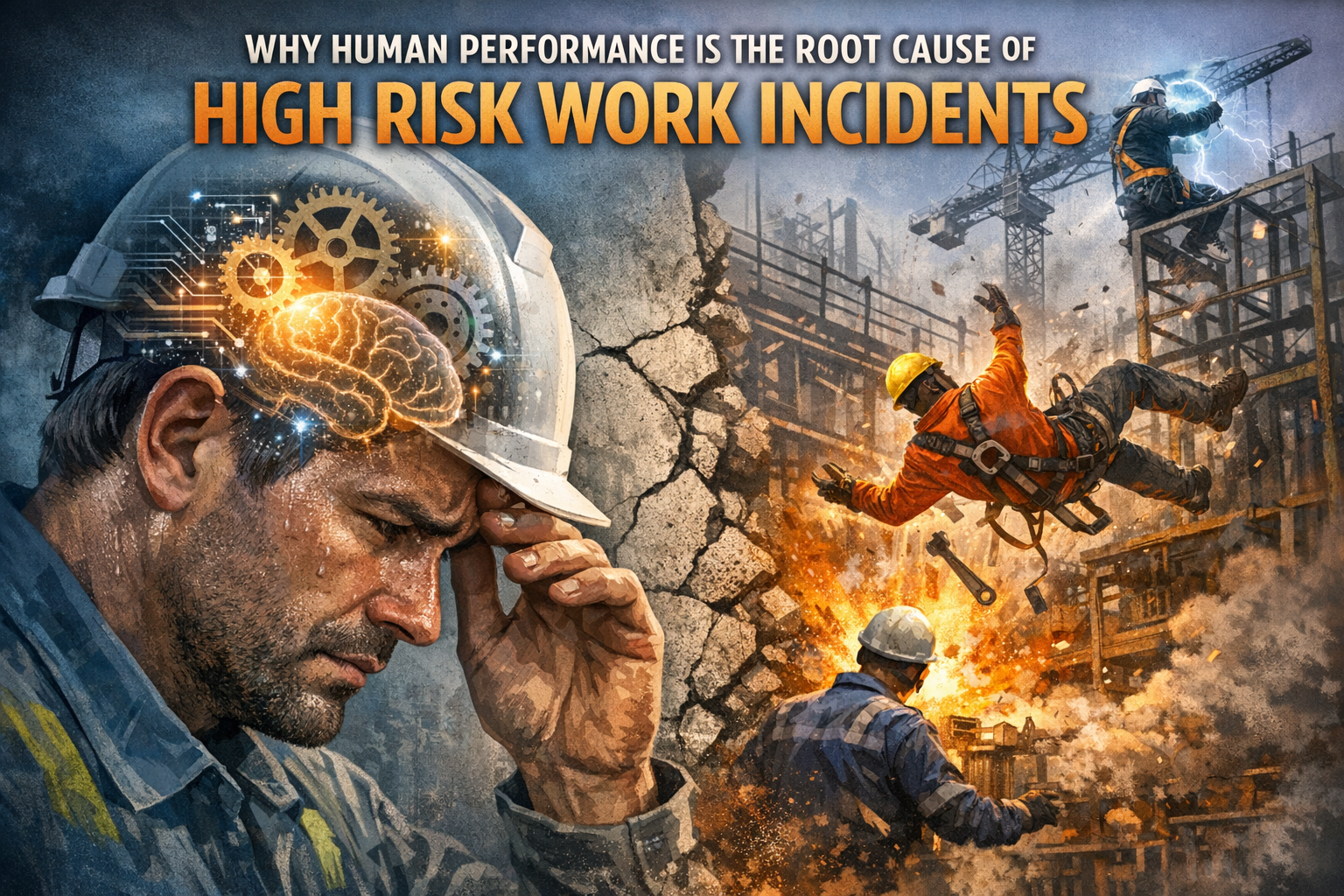
Human performance remains the leading root cause of safety failure in high‑risk work, driving breakdowns in hazard recognition, verification, and critical control execution across every major industry. We must recognize that error is an inherent aspect of human nature. Since eliminating errors entirely is often impractical, they must be planned for by implementing strategies that anticipate them and minimize their impact, with systems strengthened to withstand and recover from mistakes.
The Human Performance Gap No One Wants to Admit
- High‑risk industries have world‑class standards, procedures, and critical controls—yet fatalities persist.
- The root cause isn’t the paperwork, the systems, or even the hazards.
- It’s the human performance gap in hazard recognition, verification, and consistency.
- This gap is predictable, measurable, and solvable—but only if we stop pretending it’s a “worker problem.”
Why Humans Struggle With Hazard Recognition
Competency Gaps
- Workers often lack deep understanding of high‑energy hazards.
- Training focuses on compliance, not pattern recognition or risk sensemaking.
- New workers don’t know what “life‑altering injury potential” actually looks like in the field.
Risk Tolerance Drift
- Familiarity breeds comfort; comfort breeds blindness.
- Over‑experienced workers normalize risk (“I’ve done this a thousand times”).
- Under‑experienced workers don’t know what “bad” looks like.
Cognitive Overload
- Field workers juggle production pressure, logistics, communication, and task execution.
- Hazard recognition becomes background noise instead of a deliberate act.
Invisible Hazards
- High‑energy sources are often hidden, intermittent, or misunderstood.
- Without mental models, workers can’t connect task steps to potential catastrophic outcomes.
Why Verification Fails in the Field
Workers Don’t Know How to Mitigate the Risk
- Hazard is identified but not the correct barrier.
- Identify wrong hazards instead of high risk hazards.
- Reliance on generic controls instead of critical controls.
They Don’t Know the Standards
- Standards are complex, scattered, or inaccessible.
- Workers rely on tribal knowledge instead of authoritative guidance.
- Safeguard verification is driven from standards and procedure competency or capacity.
They Don’t Have Access to Standards
- No connectivity.
- Inconsistent mobile access.
- Lack of digital verification tools.
- Paper procedures are outdated or incomplete.
- No time to read through 20 page standard to find 3 key sections for verifying a safeguard is effectively in place.
Competing Responsibilities
- Supervisors and workers are overloaded with tasks unrelated to safety.
- Verification becomes a “check the box” activity instead of a safeguard confirmation.
- Unclear expectations and consistency gaps between different teams.
Human Performance Under Pressure
- Time pressure, production demands, and environmental stress degrade decision‑making.
- People default to shortcuts when cognitive bandwidth is low.
- Lack of evidence setting teams up for success to reduce or eliminate error-prone situations.
Why Consistency Breaks Down
Supervisors Don’t Reinforce It
- If leaders don’t model verification, workers won’t prioritize it.
- Safety becomes optional when leadership attention is inconsistent.
- Supervisors and work crew teams don’t understand what good looks like.
Nights and Weekends Are Blind Spots
- Minimal offline oversight compared to week days.
- Lack of supervisor engagement in observing high risk work tasks for verifications.
- Limited or no coaching.
- Risk increases when oversight decreases.
Different Crews, Different Work, Different Standards
- Variability in experience, culture, and expectations.
- Non‑routine work amplifies inconsistency.
- Contractors operate under different norms.
- Differences between persistent vs transient contractor expectations and engagement.
Complacency Among Highly Experienced Workers
- “I know this job.”
- “I’ve seen this before.”
- “They say no need to check.”
- Experience becomes a liability when it suppresses curiosity.
The Human Performance Root Cause
A System Designed for Perfect Humans in Imperfect Conditions
Safety systems assume workers will:
- Recognize every hazard
- Apply the correct control
- Verify every safeguard
- Do it consistently
- Under pressure
- In dynamic environments
- With incomplete information
This is unrealistic. Humans are not the weak link—they’re the least supported link. Human Performance has been the key link in traditional systems and will be the key link in modern systems.
Where Critical Control AI Fits In
Second Layer of Verification
- Digital verification reduces reliance on memory and tribal knowledge.
- AI surfaces the right controls for the specific hazard in the specific task.
Hazard Recognition Amplifier
- Pattern detection.
- High‑risk task identification.
- Real‑time prompts for triggers, hold points, and error‑prone steps.
Consistency Engine
- Standardized guidance across crews, shifts, and locations.
- Eliminates variability.
- No drift.
- Zero “off hours.”
Coaching Tool
- Conversational AI helps workers find what control to use and understand why the control matters.
- Builds capacity, not compliance.
The Future: A Connected Safety System That Supports Human Performance
One integrated data layer connecting:
- Critical controls
- Field verification
- AI insights
- Computer vision
- Human performance triggers
A system that adapts to humans instead of expecting humans to adapt to the system.
Conclusion
Fix Human Performance, and Everything Else Falls Into Place
- Hazard recognition, verification, and consistency are not worker failures—they are system design failures.
- Human performance is the root cause of safety breakdowns.
- AI‑enabled critical control systems are the path to eliminating catastrophic events.
- The future of field safety is human‑centered, AI‑supported, and verification‑driven.