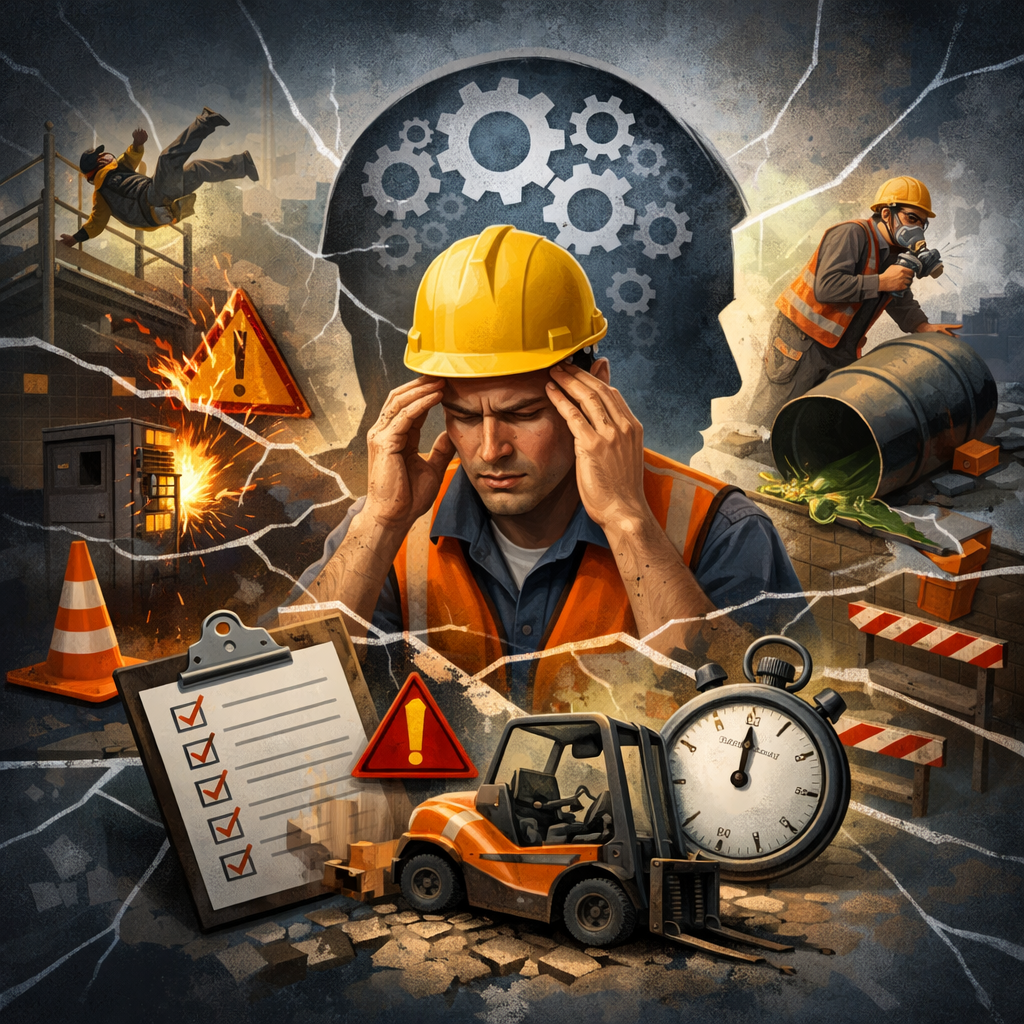
High‑risk work doesn’t fail because people are careless. It fails because human performance collapses under predictable conditions — especially when error‑prone situations, missed triggers, skipped hold points, and overwhelming cognitive load converge. In this article, we break down how these human performance factors should directly integrate into life saving safeguards, highlight work task briefings, and ensure two‑way verification behaviors are understood to keep workers safe.
Why Human Performance Breaks Down in High‑Risk Work
In high‑energy, high‑consequence environments, workers are constantly navigating conditions that push the limits of human cognition. These aren’t rare edge cases — they’re the everyday reality of field operations.
Error‑Prone Situations: The Conditions That Set Workers Up to Fail
Certain situations dramatically increase the likelihood of mistakes. Think of these situations as “human performance traps” that make the work more difficult to do. Generally error prone conditions can be categorized into the following:
- Work Environment Factors
- Task Factors
- Individual Factors
What does great look like? As a team you should:
Discuss the Factors behind Error Prone Situations
- How is the workplace, equipment or environment set-up in a manner that could make the task hard to get right?
- How is the job set up and is critical information communicated clearly?
- Are demands of today’s work exceeding the workers capability and are workers mentally ready to perform the work?
Identify what Error Prone Situations may influence Human Performance for your task
Task Factors:
- Time pressure
- Simultaneous/multiple tasks
- Irreversible actions
- Lack of or unclear standards
- Complex or badly presented procedures
- Steps where there might be insufficient time
- Unclear signs, signals, instructions, or other information
- Boring, trivial or repetitive actions
Individual Factors:
- Unclear communication
- Mental distraction
- Something is not right (gut feeling)
- Fatigue, stress, workload
- Bias
- Competency, knowledge of rules, etc.
Take action and make it “easier to get right”
Take action by discussing the Factors that apply to the task, identify any error prone situations that apply, and leverage hierarchy of controls to make it “easier to get right”.
These conditions are baked into high‑risk work. When they stack, the brain shifts from deliberate thinking to automatic mode — and safeguards become assumptions instead of verified realities.
Triggers: The Clues Workers Often Miss
They are specific and observable conditions or behaviors that provide a clue that an unmitigated hazard may be present, or an error prone situation is just around the corner. Examples of triggers where artificial intelligence can be the second layer of hazard identification and when specific conditions change during a task, such as:
- break/cut/opening location is not clearly identified
- person is in the line of fire of overhead hazard
- person ties-off to unsuitable anchor point
- person walks behind a moving piece of equipment
- an isolation tag without an appropriate lock
- an unidentified line during excavation work
Making it Easier to get Right
Establish pre-defining triggers before starting work to prompt for alerting work team. Human and computer performance working together as a concept for safer work execution.
- listen for a hissing sound from equipment indicating a leak is present
- look for temperature change in line from liquid to solid due to pressure build up
- heat sensing parameters for process equipment
Critical Control & Hold Points
Establish planned interupters drive us to pause work with critical control safety intelligence layer. Hold points should be used to determine if all necessary steps have been executed and necessary safeguards are in place before the unrecoverable step is executed. Like stop signs, they occur at pre-defined locations/times.
AI Solutions as Verification Layers
- Workers capture images, video, or voice notes during verification.
- AI identifies whether safeguards are present and functional.
- The system compares observations to procedures and critical controls.
- Leaders see trends across sites before incidents occur.
- The tool becomes a “digital safety intelligence layer” for operation