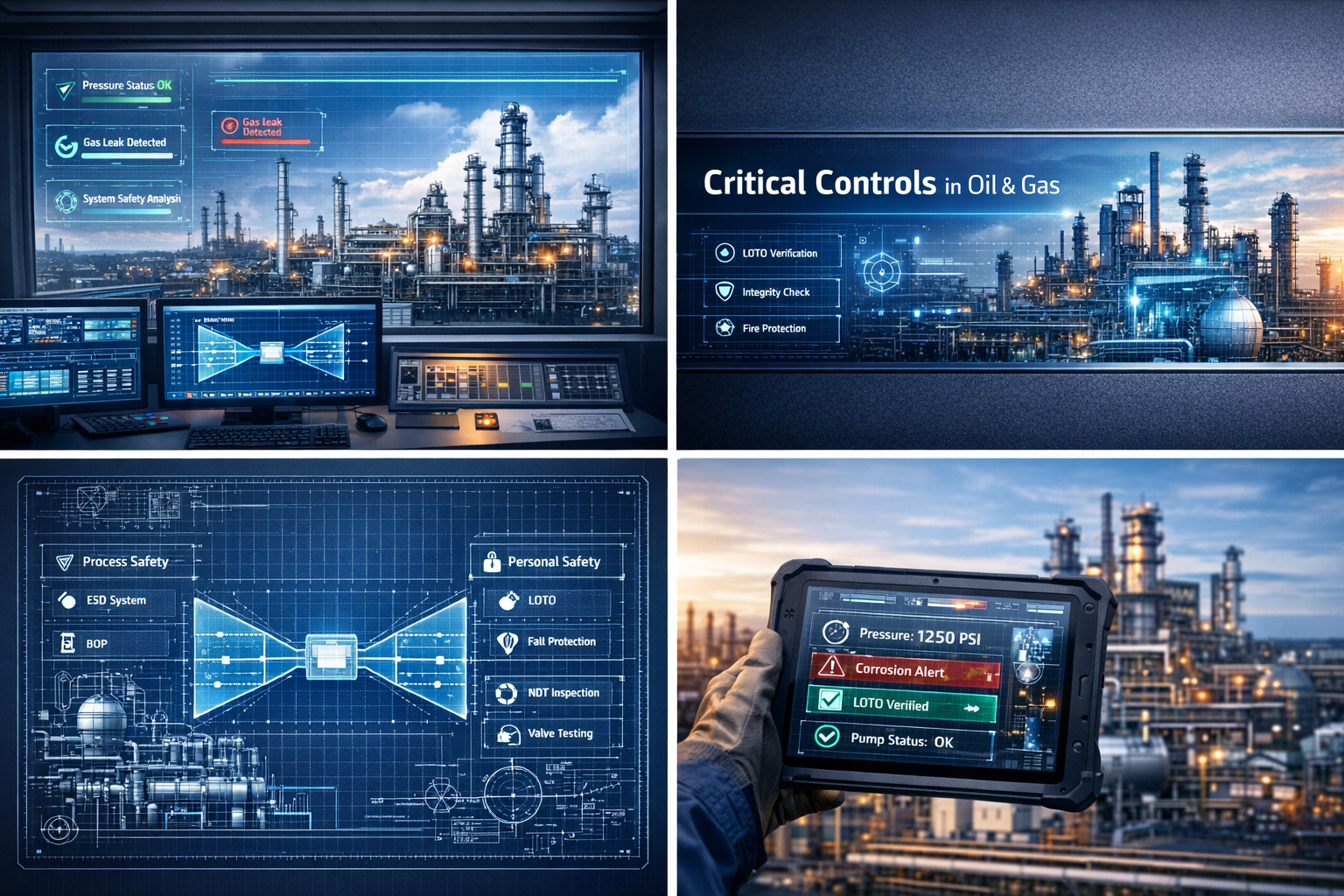
In high‑risk industries like oil and gas, safety isn’t a slogan—it’s a system. And at the center of that system lies a single idea that separates organizations that merely hope for safe outcomes from those that engineer them: Critical Controls.
Critical Controls are the safeguards that prevent catastrophic events, protect people, and ensure equipment integrity. They are the non‑negotiables—the barriers that must work, every time, under real‑world conditions.
This article breaks down the core frameworks behind Critical Controls and explains how they anchor modern safety systems across upstream, midstream, and downstream operations.
What are Critical Controls?
Critical Controls are the specific, measurable safeguards that prevent high‑consequence events such as explosions, loss of containment, dropped objects, control failures, and major equipment breakdowns. They are not generic safety rules. They are:
- Targeted to the highest-risk scenarios
- Measurable through clear performance standards
- Verifiable through field checks, sensors, and digital assurance
- Defensible to regulators and leadership
In oil and gas, Critical Controls sit at the intersection of process safety, personal safety, and equipment safeguards – the three pillars of modern risk management.
Process Safety Controls: Preventing Major Accident Events
Process safety is the discipline that keeps hydrocarbons contained and energy controlled. Critical Controls in this domain are designed to prevent catastrophic events such as fires, explosions, and toxic releases.
Examples of Process Safety Controls
- Pressure relief systems
- Emergency shutdown (ESD) systems
- Gas detection and automatic isolation
- Blowout preventers (BOPs)
- High-integrity protection systems (HIPS)
- Safe operating envelopes and alarms
Why They Matter
Process safety failures are low‑frequency but high‑consequence. When they fail, the results are immediate and severe. Critical Controls ensure that:
- Barriers are functional
- Alarms are calibrated
- Safeguards active when needed
- Operators receive early warning before conditions escalate
Process safety is the backbone of asset integrity—and Critical Controls are the backbone of process safety.
Personal Safety Controls: Protecting People in the Line of Fire
Personal safety focuses on the human side of risk—ensuring workers are protected from hazards such as dropped objects, line‑of‑fire exposures, confined spaces, and energy isolation failures.
Examples of Personal Safety Critical Controls
- Permit-to-work validation
- Lockout/tagout (LOTO)
- Confined space entry controls
- Working-at-height fall protection
- Lifting and rigging verification
- Hot work safeguards
Why They Matter
Most frontline incidents occur not because workers don’t know the rules, but because critical safeguards were assumed to be in place but weren’t actually verified.
In an effort to eliminate fatalities and life-altering injuries the International Association of Oil & Gas producers (IOGP) created nine actionable Life Saving Rules that aligns across industry.