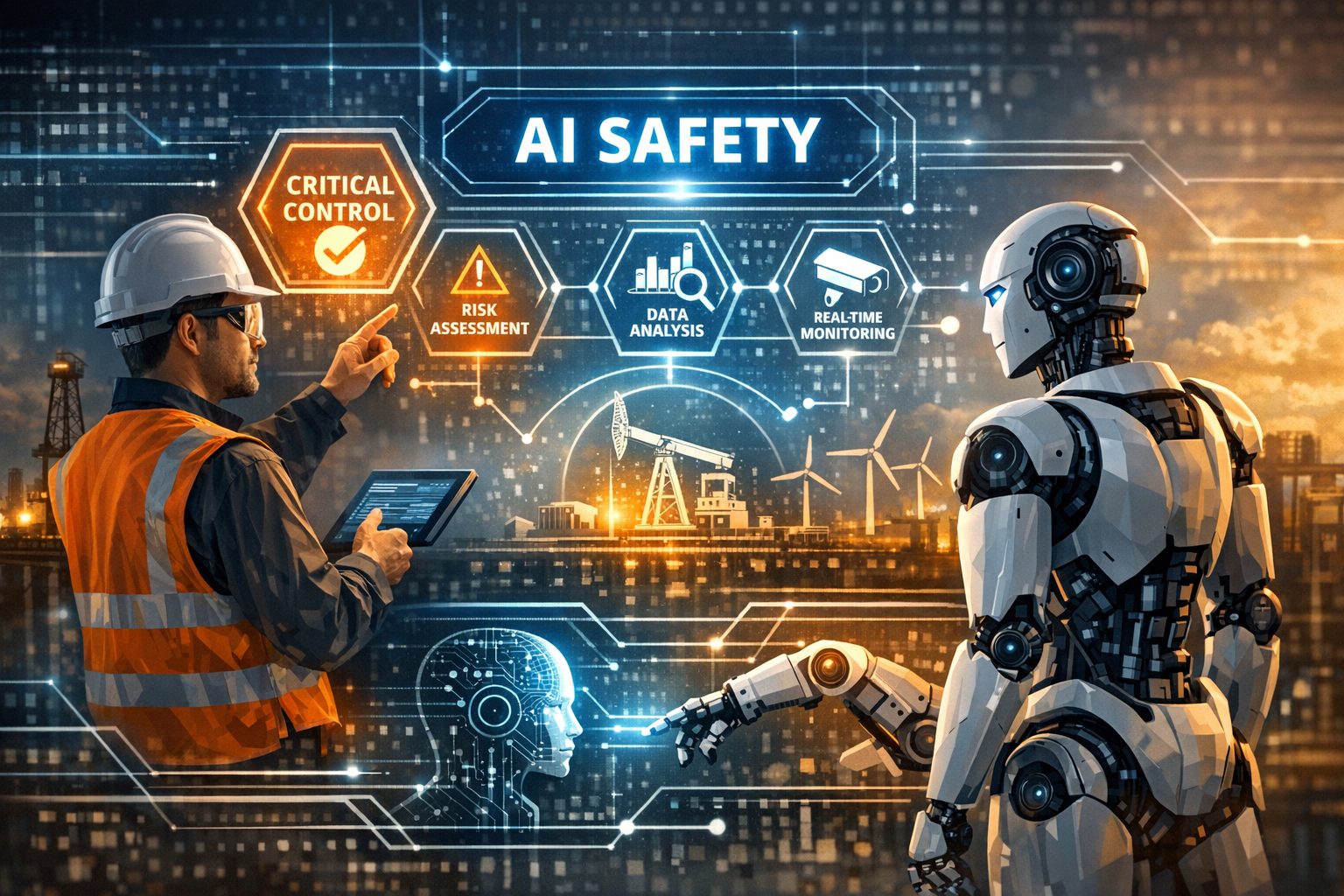
Field safety is at a crossroads. The future of field safety is changing with applied artificial intelligence and critical controls. For decades, our industry has relied on a simple belief: if we write the right procedures, train people well enough, and enforce compliance, we can prevent serious injuries and fatalities. But the truth is unavoidable — people are still dying in high‑risk work, even in organizations with mature systems, strong intentions, and world‑class standards.
It’s not because workers don’t care or because leaders aren’t committed. The way we verify work, understand risk, and support human performance hasn’t kept pace with the complexity of modern operations.
Top 7 Insights for Strengthening Future Safety Systems
1. The Verification Gap: When “Start Work Checks” Don’t Reflect Reality
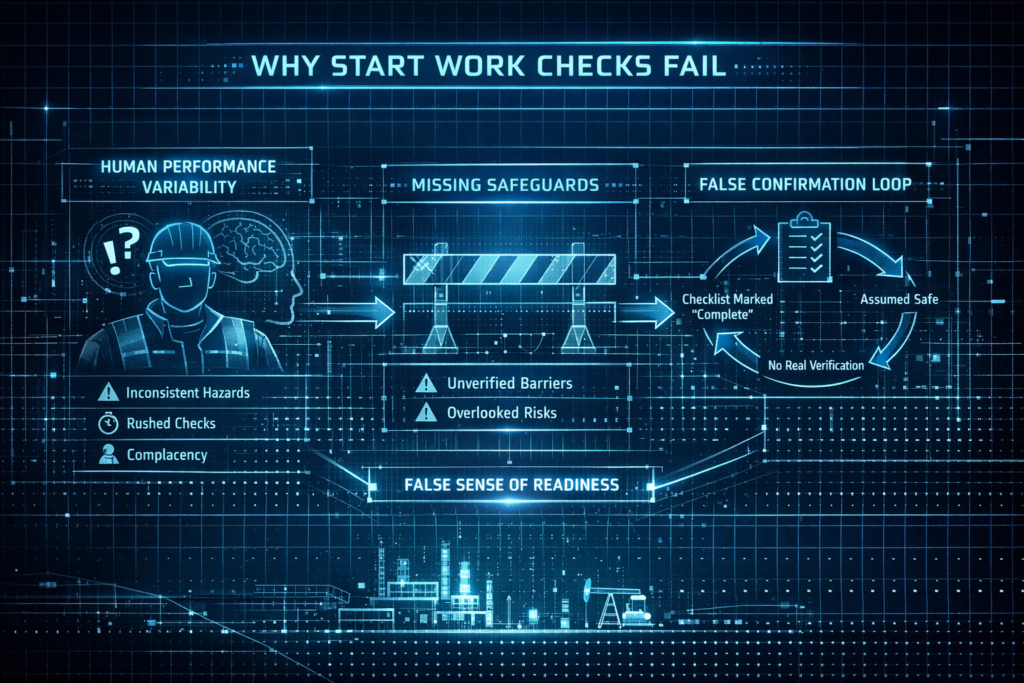
The IOGP Start Work Checks were designed to bring clarity and discipline to frontline work. But in practice, they often fail at the exact moment they matter most.
- Workers verify safeguards when someone is watching — but not always when they’re alone.
- High‑risk hazard recognition is inconsistent, especially under time pressure or routine familiarity.
- People struggle to translate abstract hazards into concrete mitigation barriers.
- Field access to standards and procedures is slow, fragmented, or nonexistent.
- Supervisors assume checks were done and work crews are competent.
The result is a false sense of readiness. A checklist says “verified,” but the field reality says otherwise. IOGP “Start Work Checks” must be two-way engagement vs. a checkbox activity to please site leadership. This is the first crack in the system.
2. Human Performance Isn’t a Weakness — It’s the Center of Safety
We’ve spent years treating human performance as something to “fix.” Humans aren’t the problem and are the only adaptive, sense‑making, real‑time risk processors in the entire system. The real issue is that we’ve built safety systems that:
- Depend on perfect human memory
- Assume consistent hazard recognition
- Expect flawless execution under pressure
- Provide little real-time support
- Fault blaming instead of learning opportunity
Workers don’t fail because they’re careless. They fail because the system didn’t set them up for success or expects superhuman consistency. The future of safety must build human capacity, not demand perfection.
Industry Best Practices – IOGP Human Performance
3. Digital Verification: The Second Layer We’ve Been Missing
Physical safeguards and procedures matter, but without digital verification, we’re relying on trust, assumptions, and paperwork as the last line of defense. Digital verification creates a second layer of defense:
- It confirms whether safeguards were actually verified
- It timestamps and contextualizes field actions
- It reduces reliance on memory and interpretation
- It connects frontline work back to standards and procedures
- It creates a consistent, structured way to capture leading indicators
This isn’t about replacing people. It’s about supporting them with a system that doesn’t forget, doesn’t fatigue, and doesn’t assume. Ultimately, shifting the focus to developing leadership behaviors and actions to build capacity.
4. Conversational AI: The Missing Link in Leading Indicators
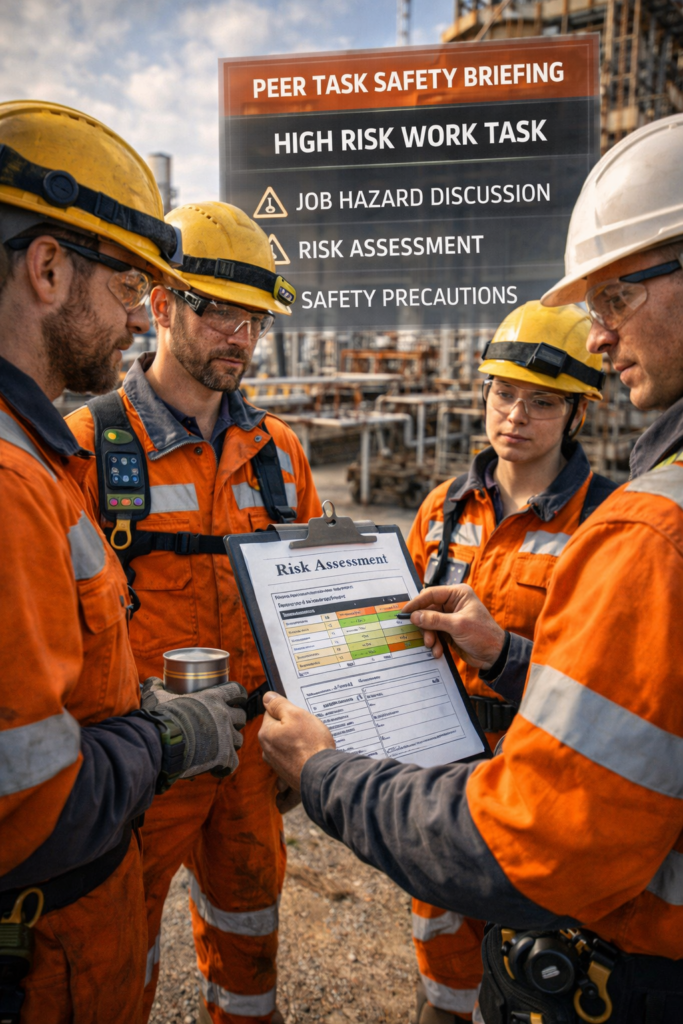
For years, leading indicators have been trapped in paper forms, generic observation cards, inconsistent coaching notes, unstructured comments, and data that never makes it back to decision-makers. Conversational AI transforms field observations into meaningful engagements that can:
- Capture field insights in natural language
- Identify patterns in verification gaps
- Highlight high‑impact areas for improvement
- Guide supervisors toward meaningful coaching
- Turn frontline conversations into structured, actionable intelligence
- Build safety competence/capacity in real time, not after an incident
This is the shift from compliance to learning. Industry is moving away from telling workers what to do and now asking them to show me you understand prior to performing high-risk work. From “Did you check the box?” to “What did we learn about the work?” AI doesn’t replace judgment — it amplifies it.
5. The Rise of Machines: Computer Vision, Automation, and the New Human–Machine Interface
Today I observed day 1 of a computer vision technology rollout for mobile equipment in warehouses focused at (WAME) Working Around Mobile Equipment “equipment-pedestrian” interaction protection. My concerns were immediately identified:
- Complacency from workers
- Over-trust in automation
- Disengage from hazard recognition
- Technology creating new failure modes and hazards not anticipated
Add to that an automated pallet‑moving machine — essentially a robotic vacuum with industrial consequences — navigating the same space as humans. This is the new frontier of human performance. Machines don’t eliminate risk, they change the shape of it. Without critical controls, fail‑safe design, and human‑centered integration, automation can create a false sense of security that erodes the very behaviors we rely on to keep people safe. The future of safety must ensure that technology enhances human performance, not replaces it.
6. The Industry Shift: From Compliance to Engagement and Learning
The old model — compliance, enforcement, policing — is fading. It never scaled, it never adapted, and it never built capacity. The new model is engaging, learning-driven, human-centered, data-connected, AI-supported, verification-focused, and system-aware.
This is not a philosophical shift. It’s a practical one. Compliance doesn’t prevent fatalities, capacity does. Safety works a lot like sports: the final score doesn’t always tell you how well the team actually played. A win on the scoreboard doesn’t guarantee good performance, and a loss doesn’t mean the fundamentals were not strong.Safety isn’t the absence of injuries, its the presence of disciplined, reliable performance.
7. The Future: One Connected Safety System
Right now, safety systems are fragmented into observations, start work checks, procedures, critical controls, training, audits, incident data, AI technologies and many more components that function separately. They live in different tools, different formats, and different teams. The future requires one connected data box — a unified architecture where:
- Field verification
- Human performance insights
- Safeguard validation
- AI analysis
- Automation signals
- Leading indicators
- Standards and procedures
- Coaching engagements
- Team target areas (monthly learnings and progress)
This is how we finally close the loop between work as imagined and work as done building an environment of continuous integrated learning.
The Call to Action
Field safety is entering a new era — one defined not by paperwork, but by verification, capacity, and intelligence. We must:
- Support workers with digital tools that reduce cognitive load
- Use AI to identify the right improvement targets
- Build systems that learn from the field, not judge it
- Integrate machines in ways that strengthen, not weaken, human performance
- Treat safeguards as living, verifiable elements of work
- Move beyond compliance into meaningful engagement
- Connect every part of the safety system into one intelligent architecture
Because the truth is simple: Fatalities don’t happen because people don’t care. They happen because our systems aren’t yet designed for how work actually happens. The future of field safety is human, is digital, is intelligent and is starting now.
Explore Field Safety Frameworks – Critical Control AI – Home Page
Who is the blog for – Critical Control AI – About Page